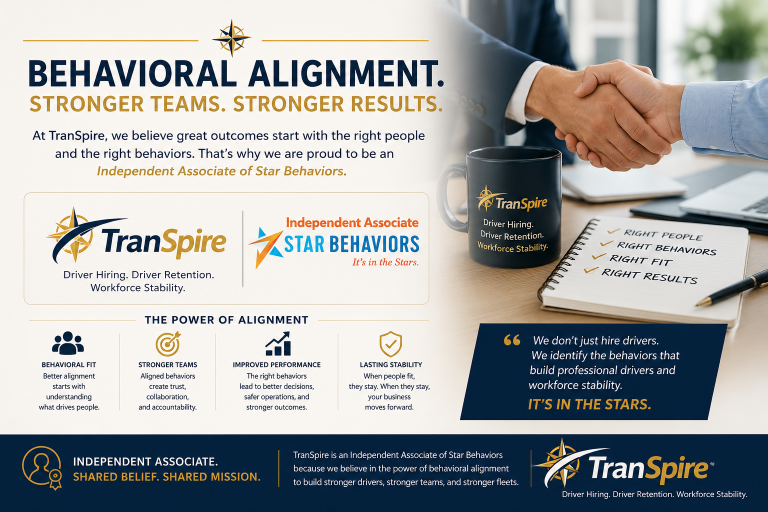
Determining driver fit...
Behavioral Alignment
Hiring for Alignment - Not Just Qualifications
Many hiring decisions focus solely on qualifications. Such as:
- Licensing.
- Experience.
- Driving Record.
- Availability.
While these elements remain necessary, they rarely, if ever, determine long-term stability. Behavioral alignment often plays a larger role.
Behavioral Alignment Integration
Behavioral alignment assesses whether a driver's natural work style fits the operational environment.
Key factors include:
- Communication style.
- Response to structure.
- Independence versus collaboration.
- Stress tolerance.
Drivers whose behavioral patterns align with operational expectations often integrate more successfully.
Why Alignment Matters
Misalignment can and does create friction between:
- Drivers and dispatch.
- Drivers and operational processes.
- Drivers and company culture.
Over time, this friction contributes to instability.
Executive Consequences
Misalignment increases:
- Early driver turnover.
- Onboarding disruption.
- Recruiting pressure.
Behavioral alignment provides an additional lens for evaluating workforce stability.
Transition
Ultimately, workforce instability creates measurable financial consequences for fleet operations.
For Additional Information
Contact us by clicking the link below or reach out to Star Behaviors directly. Let TJ know that you were on our site.